


How to Participate
How to Join and Participate in City Council Meetings
How can I attend or participate in a City Council meeting?
There are several ways to join in — in person, by phone, or online. You can speak during the meeting in real time or submit a written comment ahead of time. This page walks you through everything you need to know to show up and make your voice heard.
Instructions, participation information, and translated resources are available in multiple languages.
On this page:
- Start Here
- How to Participate
- General Participation Rules
- Non-Agenda Public Comment
- Submitting Written Materials
- Viewing Meetings
- Subscribe to Agenda Updates
- Organized Presentations
- Late Arriving Materials
- If There Are Technical Difficulties
- City Council Meeting Process
- Understanding the Agenda
- Language & Accessibility
- Agenda & City Council Glossary
Start Here
Why does City Council participation matter?
City Council decisions shape the things that directly affect your daily life — streets, housing, parks, public safety, neighborhoods, and City services. When you participate, you have a real opportunity to influence those decisions before they're made.
How to Participate
Review the Agenda
How do I find out what's on the agenda before a meeting?
Agendas are typically posted every Wednesday at 10 a.m. for meetings happening the following week. Each item includes a number, a title, and links to supporting documents like staff reports, ordinances, and resolutions — so you can review the details and decide whether you'd like to comment.
Is there a shorter, at-a-glance version of the agenda I can check first?
Yes — the City publishes a Summary Agenda that lays out the anticipated order of business and consolidates all items into one convenient document. It may include Closed Session items, Housing Authority matters, Public Facilities Financing Authority items, and estimated public comment times for each discussion item. The Summary Agenda is posted on Friday afternoons and is available at sandiego.gov/cc. Keep in mind it's a helpful guide, not a replacement for the full official agenda and supporting materials.
Note: Translated agendas and summary agendas are provided as a courtesy to enhance public access. In the event of any discrepancy, the English-language agenda is the official version. See the glossary for common agenda terms.
Attend a Meeting
Where and how can I join a City Council meeting?
Meetings are held in a hybrid format, so you can choose what works best for you:
- In person — Council Chambers, 202 C Street, 12th Floor, San Diego, CA
- Online — join the live meeting at sandiego.gov/councilmtg
- By phone — dial 1-669-254-5252 and enter the Webinar ID posted on the agenda
City Council meetings use the Zoom Webinar platform. Whether you're joining to listen or to offer public comment on an agendized item or during Non-Agenda Public Comment, you can access the meeting from a desktop computer, laptop, tablet, or smartphone — or call in from any smartphone, cell phone, or landline. If you're participating by phone, press ★9 to raise your hand and ★6 to unmute yourself when called on.
Provide Public Comment
Can I submit a comment before the meeting even starts?
Yes! You can submit a written comment in advance using the public comment webform. When submitting, indicate the comment type and the relevant item number.
- Deadline for distribution: Comments received by at least two hours before the start of the meeting will be distributed to the City Council and posted online.
- Late submissions: Comments received less than two hours before the start of the meeting, up until the meeting concludes, will still be added to the written record for the relevant item.
- Word limit: Webform comments are limited to 500 words but may include attachments.
How do I speak at a meeting in real time?
That depends on how you're joining:
- In person — complete a speaker slip with the City Clerk at the meeting, indicating which item you wish to speak on. Slips are only accepted on the day of the meeting and before in-person testimony concludes on that item — they can't be turned in early. When it's your turn, approach the podium, and if you're representing an organization or another person, please say so.
- By phone — join using the phone number and Webinar ID posted on the agenda, then raise your hand when prompted
- Online — join through Zoom Webinar and use the "Raise Hand" feature when your item is called
Note: In-person testimony concludes before virtual testimony begins, so if you're joining remotely, plan for a brief wait while room-based speakers finish. If you're commenting virtually, you'll need to raise your virtual hand before the queue closes — the queue closes when the last virtual speaker finishes or five minutes after in-person testimony ends, whichever comes first.
Raise Your Hand to Speak
How do I raise my hand to speak during the meeting?
It's straightforward no matter how you're joining:
- On a computer: Reactions → Raise Hand
- On a phone or tablet: Reactions → Raise Hand
- If calling in: Press ★9 to raise or lower your hand
When called on, unmute using your device controls or press ★6 if dialing in by phone.
Prepare Your Message
What's the best way to prepare what I want to say?
Keep it focused and clear. Here's a simple format that works well — you don't have to follow it exactly, but having a structure helps you make the most of your time:
- Introduce yourself — optionally share your name and neighborhood
- Mention your position on the agenda item — say if you are for or against the item
- Share your message — briefly explain your main point or concern
- Make your request — clearly state what action you would like the Council to take
Speaking Time Limits
How much time will I have to speak?
Speaking time varies by item type. All time limits are at the discretion of the Council President and may be adjusted for better meeting management:
| Item Type | Time Allowed |
|---|---|
| Closed Session | 1 minute per item; up to 3 minutes max if 3 or more items |
| Proclamations | 1 minute per item; up to 3 minutes max if 3 or more items |
| Consent Agenda | 1 minute per item; up to 3 minutes max if 3 or more items |
| Discussion & Information Items | Time allocations per person are listed with each item on the agenda; requests for organized presentations may pool their time. |
| Non-Agenda Public Comment | 2 minutes per person, per meeting |
What about Quasi-Judicial items — are those handled differently?
Yes. For Quasi-Judicial items (such as land use appeals), the Applicant and/or Appellant receives up to 10 minutes for their own organized presentation immediately following the City's presentation. If the City's presentation runs longer than 10 minutes, that time may be extended accordingly.
What if a lot of people want to speak on the same non-agenda topic?
If eight or more speakers address a single issue during Non-Agenda Public Comment, the maximum cumulative time for that issue is capped at 16 minutes total for in-person and 16 minutes total for those participating online. This helps ensure a broader range of voices can be heard across the full meeting.
General Participation Rules
Are there any basic ground rules I should know before I participate?
A few things to keep in mind going in:
- You may only provide one comment per agenda item
- Non-Agenda Public Comment needs to be about a subject matter within the jurisdiction of the City Council
- If you are part of an Organized Presentation, click here to see how to sign up.
If I'm attending virtually, when will I get to speak relative to in-person speakers?
In-person testimony always concludes first, before virtual testimony begins. So if you're joining remotely, plan for a brief wait while room-based speakers finish before your turn comes up.
Non-Agenda Public Comment
Can I speak about something that isn't on the agenda?
Yes. Regularly scheduled Council meetings include time for Non-Agenda Public Comment, which lets you address matters of public interest that fall within the Council's jurisdiction — even if the topic isn't listed on that day's agenda. Each speaker gets up to 2 minutes.
When does Non-Agenda Public Comment happen during a meeting?
The timing depends on the day of the meeting:
- Mondays — Taken during the 2:00 PM session, after all discussion items are complete
- Tuesdays — Taken during the 10:00 AM session
How is the speaking order determined for Non-Agenda Public Comment?
Generally, it's first-come, first-served. However, priority may be given to speakers who did not address the Council during Non-Agenda Public Comment at the last regularly scheduled meeting — so if you spoke last time, you may be placed further back in line this time around.
Submitting Written Materials and Audio/Visuals
Besides the webform, can I mail in written materials?
Yes. You can mail written materials to:
City Clerk
202 C Street, MS2A
San Diego, CA 92101
To be distributed to the City Council, materials must arrive no later than one business day before the meeting. Written materials received via mail on the day of the meeting will still be entered into the written record.
Can I submit audio or visual materials to use during my comment?
Yes. Submit any audio or visual media you'd like to use at www.sandiego.gov/materials at least 2 hours before the meeting.
Viewing Meetings
What if I just want to watch a meeting without participating?
You have a couple of easy options:
- On TV (within City of San Diego only) — Watch on City TV Channel 24 (Cox Communications and Spectrum) or Channel 99 (AT&T U-Verse)
- Online — Stream the meeting at sandiego.gov/communications/citytv
Subscribe to Agenda Updates
Is there a way to get agendas sent to me automatically?
Absolutely. Sign up to receive City Council agendas and related updates directly in your inbox — so you're always in the loop before a meeting takes place.
Organized Presentations
What if a group of us wants to speak together on the same topic?
Two or more people who share a position can participate as an organized presentation, with a lead speaker or a few speakers presenting on behalf of the group. The amount of time allotted is based on how many people are listed — so be sure to include everyone when you sign up. Presentations are a max of 15 minutes.
How do we sign up for an organized presentation?
The lead presenter must submit a request at least 24 hours before the meeting via the Organized Presentation Request webform. If you're using a slideshow, video, or audio, you can attach it to the form — or submit it separately via a follow-up link at least 2 hours before the meeting.
Important: Everyone listed as part of the organized presentation must be present. If someone doesn't show up, the allotted speaking time will be reduced accordingly.
Does it matter whether our group attends in person or virtually?
Yes — all participants in an organized presentation must use the same attendance format, meaning everyone attends either all in person or all virtually. If your group submits a mix of formats, speaking time will be reduced based on how the lead presenter is attending.
Late Arriving Materials
What happens if new documents are added close to or during the meeting?
Under the Brown Act — California's open meetings law — any public records related to agenda items distributed to a majority of the City Council within 72 hours of a meeting must also be made available for public inspection. Here's where you can find them:
- Online — Available at sandiego.gov/cc as an attachment to the related item
- In Council Chambers — Available at digital kiosks inside the chamber and on the Lobby and 12th Floors
- During the meeting — Look for the binder labeled "Late Arriving Materials" near the entrance of Council Chambers (for City-prepared documents); materials prepared by others will be posted online after the meeting
If There Are Technical Difficulties
What happens if there's a technical problem during the meeting?
If the City experiences technical issues that disrupt online or phone-based participation, the meeting may be paused while staff works to restore access. The City will make every reasonable effort to get things back up and running quickly. If the issue can't be resolved, the City Council may take appropriate action consistent with State law.
Need help with meeting access? Contact the Office of the City Clerk at cityclerk@sandiego.gov or 619-533-4000.
City Council Meeting Process
What order does business happen in during a meeting?
The order is different depending on the day:
- Monday — The day starts with a 10 a.m. session set aside specifically for Closed Session public comment. Once that wraps up, the Council moves into Closed Session itself, which isn't open to the public. The Council then returns to open session at 2 p.m., where Discussion Items are heard, followed by Non-Agenda Public Comment.
- Tuesday — The 10 a.m. session covers Proclamations, the Consent Agenda, morning Discussion Items, and Non-Agenda Public Comment. After that, there's a break, and the Council reconvenes at 2 p.m. for the afternoon session to continue with Discussion Items.
The Summary Agenda is your best tool for seeing the anticipated order for a specific meeting, since the actual sequence can shift.
What's the difference between Closed Session and the regular meeting?
Closed Session covers items the Council is legally permitted to discuss privately — most often pending litigation, real property negotiations, or certain personnel matters. The Closed Session itself isn't open to the public, but on Mondays the public does get a chance to weigh in first: the 10 a.m. session is set aside specifically for public comment on the Closed Session items before the Council adjourns into Closed Session. The Closed Session Reports note what was decided once there is something to report out. Everything else on the agenda is part of the open meeting, where the public can watch and participate throughout.
How does the Council actually decide on an item?
A Councilmember makes a motion on the item, another Councilmember seconds it, and the Council votes. The motion has to pass with the required number of votes before it passes. If a motion fails to receive the required votes or no one seconds it, the Council moves on or someone offers an alternate motion.
How is what happens at the meeting officially recorded?
The City Clerk's office keeps the official record through the meeting minutes, prepared by the Legislative Recorder. Minutes capture what was done — the motions made, who made and seconded them, and how each Councilmember voted — rather than a transcript of what was said. If you want a record of the discussion itself, including public comments, the video of each meeting and a summary of results is posted online within 24–48 hours and is kept on file.
Do meetings happen on a regular schedule?
Yes. Regular Council meetings are held weekly, typically split between a Monday afternoon session and a Tuesday morning session, the schedule of meetings can be found on the Legislative Calendar adopted each year by the City Council. Special or supplemental meetings can be called outside that schedule when needed, and those will always be separately noticed in accordance with the Brown Act.
Understanding the Agenda
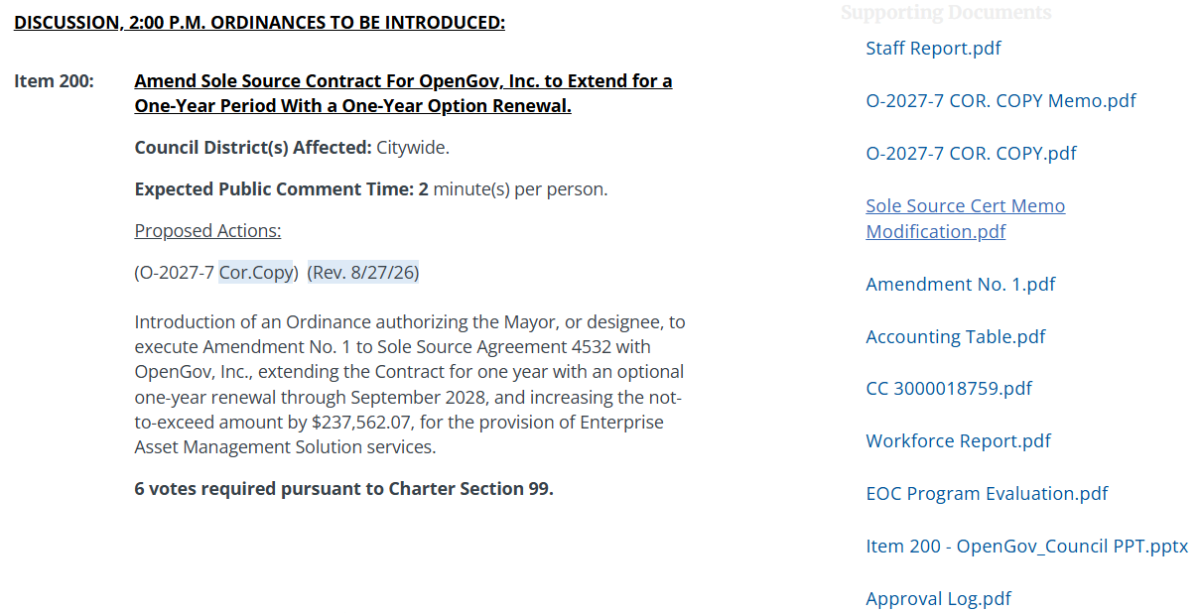
An agenda is the meeting plan. Here's what you'll see:
- Item Number & Title — the topic being discussed
- Public Comment Time — time allocations listed with each Discussion and Informational item on the agenda; Organized Presentation requests may be submitted to pool time together.
- Proposed Actions — what the Council may approve, adopt, or discuss
- Staff Report — background, recommendations, and fiscal information
- Attachments — reports, maps, presentations, ordinances, or resolutions
When viewing the agenda online, each item title is clickable and will display related documents, including staff reports, ordinances, resolutions, and supporting materials.
The Consent Agenda includes routine, non-controversial items, or items that were previously on discussion but require a second reading before the City Council may approve. All items on consent are taken with a single vote.
Any item may be pulled from Consent for separate discussion by a member of the City Council.
Items that require more explanation, debate, or public input before a decision.
An item that requires advance public notice before the hearing or meeting.
A formal expression of City Council action or authorization. It is adopted in a single meeting.
A local law or approval. Ordinances require two readings: Introduction and Adoption.
Language & Accessibility
The Office of the City Clerk aims to provide meaningful access to City Council meetings and meeting materials. Translated resources, interpretation assistance, and disability-related accommodations are available to help members of the public participate.
If you need language assistance, interpretation, or disability-related accommodations, please contact the Office of the City Clerk as early as possible before the meeting at cityclerk@sandiego.gov or at 619-533-4000.
Agenda translations
The City provides translated agenda resources in multiple languages to improve public access.
| Monday | Tuesday |
|---|---|
Disclaimer: Translated agendas are provided as a courtesy to enhance public access. In the event of any discrepancy, the English-language agenda is the official version.
Request language assistance or space accommodations
The City is committed to addressing language interpretation requests swiftly in order to maximize public participation. Individuals requesting interpretation space will be able to have designated area reserved in an adjacent room.
In addition, requests for interpretation services to provide public comment may be made by contacting the Office of the City Clerk at:
- Email: cityclerk@sandiego.gov
- Phone: 619-533-4000
Agenda & City Council Glossary
This glossary explains common terms used in City Council meetings and agendas in simple, plain language.
A
Adjourn – To officially end a meeting after completing the agenda.
Adjournment in Memory – A short tribute at the end of a meeting honoring someone who has passed away.
Agenda – The meeting plan that lists all items to be discussed or voted on.
Agenda Item – A specific topic or issue listed on the agenda.
Amendment – A change to an item, motion, or ordinance most often that what was proposed.
Attachment – A supporting document linked to an agenda item, such as a report, map, or presentation.
B
Brown Act – California's open meetings law ensuring public access and participation.
C
City Clerk – The City Official responsible for records, agendas, and support for City Council meetings.
City Council – The elected body that makes laws and policy decisions for the City.
Closed Session – A private portion of a meeting for limited confidential matters allowed by law.
Committee – A smaller group of Councilmembers that studies specific issues and makes recommendations.
Consent Agenda – Routine items or items returning for second reading approved together unless an item is pulled for separate discussion.
Continued Item – An item postponed to a later meeting with a specific date.
Council President – The Councilmember who presides over the meeting.
D
Discussion Agenda – Items that require explanation, debate, or public input before a vote.
Date of Final Passage- Is the date that the Ordinance or Resolution was returned to the Office of the City Clerk by the Mayor. For most Ordinances they take effect 30 days after that date of final passage or as outlined in the Ordinance.
F
Fiscal Impact – The financial effect of a proposed action.
H
Hybrid Meeting – A meeting that allows participation both in person and remotely.
I
Information Item – Shared for awareness only; no vote is taken.
Item Number – The number assigned to each agenda item.
L
Late-Arriving Materials – Documents submitted after the 72-hour time frame that the agenda is posted but before or during the meeting.
M
Minutes – The official written record of what happened during a meeting.
Motion – A formal proposal to take action.
Moved / Seconded – When one Councilmember proposes a motion and another supports it before voting.
N
Non-Agenda Public Comment – Time for the public to comment on topics not listed on the current agenda, but within the subject matter jurisdiction of the City Council.
Noticed Hearing – Public notice given before certain hearings or land use items.
O
Ordinance – A formal City law or regulation adopted by the Council.
Organized Presentation – An organized presentation allows two or more people sharing a common position on an agenda item to combine their public comment time and speak through one or more lead presenters at a City Council meeting
P
Policy – A rule or guideline set by the Council.
Proclamation – A Ceremonial statement recognizing a person, event, or cause.
Public Comment – When members of the public share input on agenda items or general topics.
Q
Quorum – The minimum number of Councilmembers required to hold a meeting.
R
Resolution – A formal Council action expressing a decision or authorization that is not a law.
Roll Call – When each Councilmember's name is called to confirm attendance or record votes.
S
Second Reading – The final reading before adoption.
Subitem – A smaller part of a main agenda item.
Supplemental Materials – Additional documents related to an agenda item.
V
Vote – The formal action by Councilmembers to approve or reject an item.
Veto- Is when the Mayor rejects an action or law passed by the City Council. A Mayoral veto is allowed for certain items which would require the item to return to Council for a super majority (6 votes) to supersede the rejection.
W
Written Comment – A public comment submitted online or in writing.
Webinar ID – The Zoom meeting code used to join a meeting remotely.